

Key Moments
Scope of the Advertising Ban
Amsterdam prohibits meat advertisements visible in public spaces but allows ads at the location selling the product.Transition and Enforcement Timeline
The ban began May 1, 2026, with enforcement and fines starting from January 1, 2027.Broader Food Strategy Goals
Amsterdam aims for 60% of its protein consumption to come from plants by 2030 to benefit health and environment.Legal and Public Health Context
The ban reflects debates on advertising legality, public health risks of processed meat, and environmental impacts.Amsterdam has officially changed the rules for what can be advertised across its public-facing streetscape.
Since May 1, 2026, the Dutch capital’s local ordinance has prohibited advertising intended to promote meat products when those ads are visible from public roads or other publicly accessible places.
But there’s an important detail that can get lost in the headline:

Amsterdam did not ban meat. And it did not ban businesses from advertising the meat they sell at their own locations.
The city is drawing a narrower line around the promotion of meat through the broader outdoor advertising environment.
And even though the rule is already legally in effect, Amsterdam is treating 2026 as a transition year. Active enforcement and fines are not expected to begin until January 2027.
What Amsterdam actually banned
The language in Amsterdam’s amended General Local Ordinance is unusually specific.
It defines a “meat advertisement” as advertising clearly intended to promote products that, based on their appearance, name or another characteristic, consist wholly or partly of dead animals intended for human consumption.
That covers the kind of advertising people encounter away from the point of sale—billboards, street displays and other outdoor promotions visible from publicly accessible areas.
The same ordinance also restricts advertising for several fossil-fuel-related products and services, including air travel, cruises, gasoline-powered vehicles and certain energy contracts.
The measure has been described as making Amsterdam the first capital city in the world to prohibit both meat and fossil-fuel advertising in public spaces.
Restaurants and supermarkets can still advertise what they sell
The rule contains an important exception.
Advertising remains permitted at or in the immediate vicinity of the premises where the product is actually offered.
That means a butcher can advertise meat around the butcher shop. A supermarket can promote meat at its store. Restaurants can continue advertising the dishes they serve around their own locations.
People can still buy meat, restaurants can still serve it, and retailers can still sell it.
What changes is the city’s larger advertising environment.
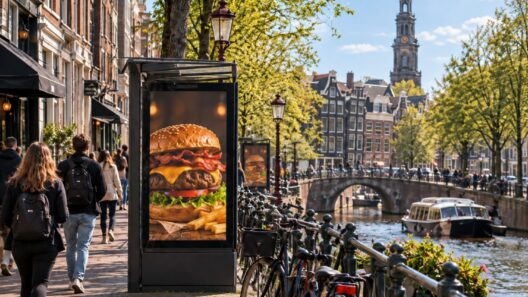
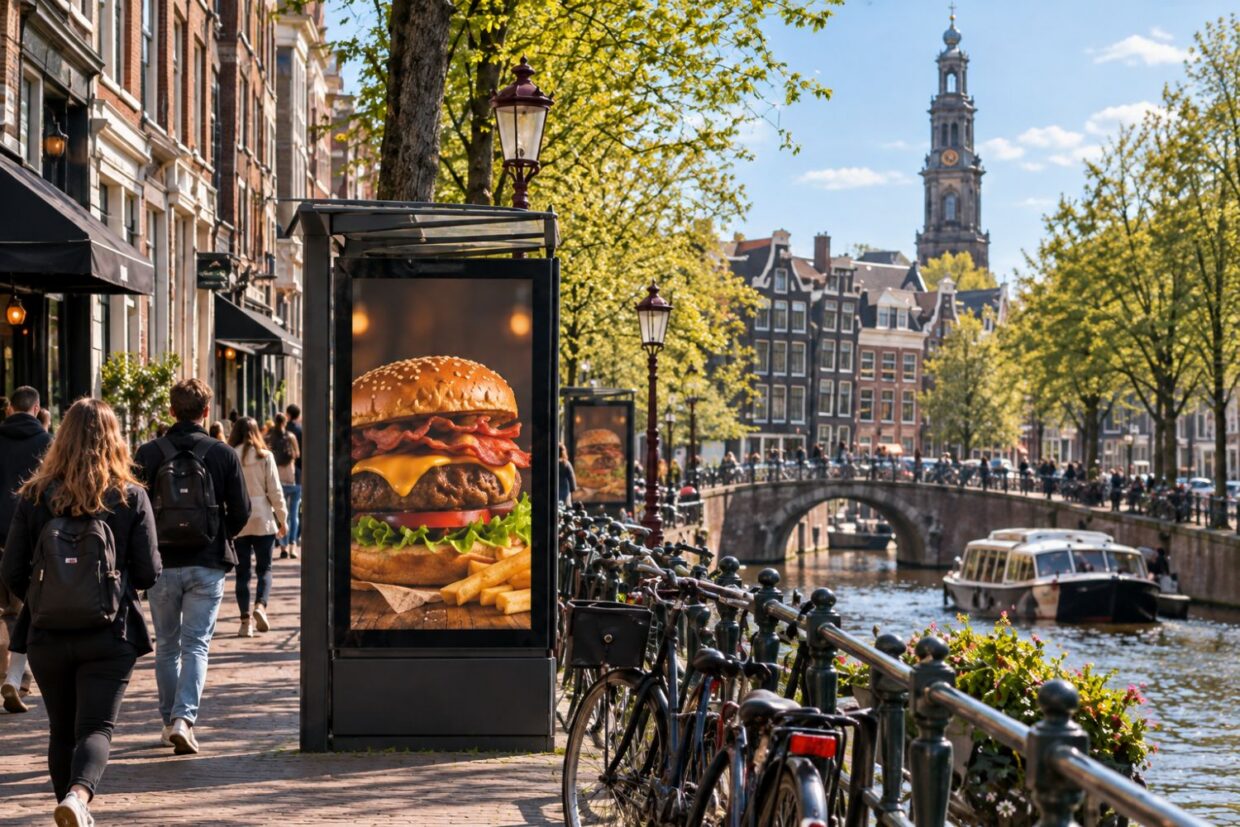
A burger company, for example, can no longer simply purchase the same kind of citywide outdoor exposure for meat products that it previously could.
That distinction makes the policy less about prohibiting a product and more about deciding which products receive a promotional platform across shared public space.
Why you may still see meat advertisements in Amsterdam
This is another detail worth understanding.
The ban officially entered into force on May 1, 2026, but Amsterdam is not immediately issuing fines.
City officials said the short period between approval of the ordinance and its implementation created problems for existing advertising contracts and gave operators too little time to adjust.
As a result, 2026 is effectively functioning as a transition period, with active enforcement expected from January 1, 2027.
So seeing a meat advertisement in Amsterdam today does not necessarily mean the policy disappeared or was reversed.
Some existing advertising is being phased out.
There may also be less meat advertising involved than the size of the debate would suggest. During the political discussion surrounding the measure, Amsterdam alderman Melanie van der Horst said meat represented only about 0.1% of the city’s outdoor advertising, while also warning about existing contracts and possible legal complications from implementing the ban quickly.
The policy is part of a much bigger change in how Amsterdam wants to eat
The advertising restriction isn’t happening in isolation.
Amsterdam’s food strategy has set a target for 60% of the protein consumed in the city to come from plant sources by 2030.
Recent city research estimated that Amsterdam residents were already getting about 48% of their protein from plant sources, compared with 43% across the Netherlands overall.
The city says encouraging more plant-based and less animal-based eating can benefit both health and the environment.
Amsterdam and 11 large organizations in the city have also been changing their own catering as part of that broader protein transition.
In other words, the advertising rule is one piece of a much larger food-policy strategy rather than a standalone attempt to eliminate meat from Amsterdam.
There is also a public-health conversation around meat
The debate around meat is not limited to climate policy.
The World Health Organization’s International Agency for Research on Cancer classifies processed meat as carcinogenic to humans, based on sufficient evidence that consuming processed meat causes colorectal cancer.
Red meat is classified as probably carcinogenic to humans, a category based on a different and less conclusive level of evidence.
Those classifications are frequently misunderstood.
Being placed in the same hazard category as another carcinogen does not mean two exposures carry the same level of risk. IARC’s categories describe the strength of evidence that something can cause cancer, not how dangerous one exposure is compared with another.
That distinction matters when meat advertising and public health are discussed together.
Not everyone agrees that advertising should be restricted
The policy has also drawn criticism.
Some advertising and industry voices have argued that legal products should generally remain legal to advertise and have characterized the measure as unnecessarily paternalistic or restrictive.
Amsterdam officials themselves raised practical concerns during debate over the ordinance, including existing advertising contracts, enforcement costs and possible legal disputes.
Supporters of the measure make a different argument: if a city is deliberately trying to reduce the environmental impact of consumption, allowing unlimited promotion of the products it is simultaneously trying to reduce creates competing messages.
That disagreement gets at the more interesting question behind Amsterdam’s experiment.
The product is still legal. The advertising space is what changed.
For decades, advertisements for burgers, chicken, flights, cars and countless other products have simply formed part of the background of city life.
Amsterdam hasn’t decided that people are no longer allowed to choose meat.
It has decided that the ability to sell a product and the right to promote that product throughout shared public-facing spaces are not necessarily the same thing.
Whether that approach meaningfully changes what people eat will take time to measure.
But Amsterdam has already changed something more immediate:
Meat advertising is no longer automatically treated as an ordinary part of the city’s public landscape.
Sources
Amsterdam General Local Ordinance; City of Amsterdam Food Strategy; Amsterdam Research & Statistics food-monitoring data; World Health Organization / International Agency for Research on Cancer; reporting from The BMJ, BBC, DutchNews and NL Times.